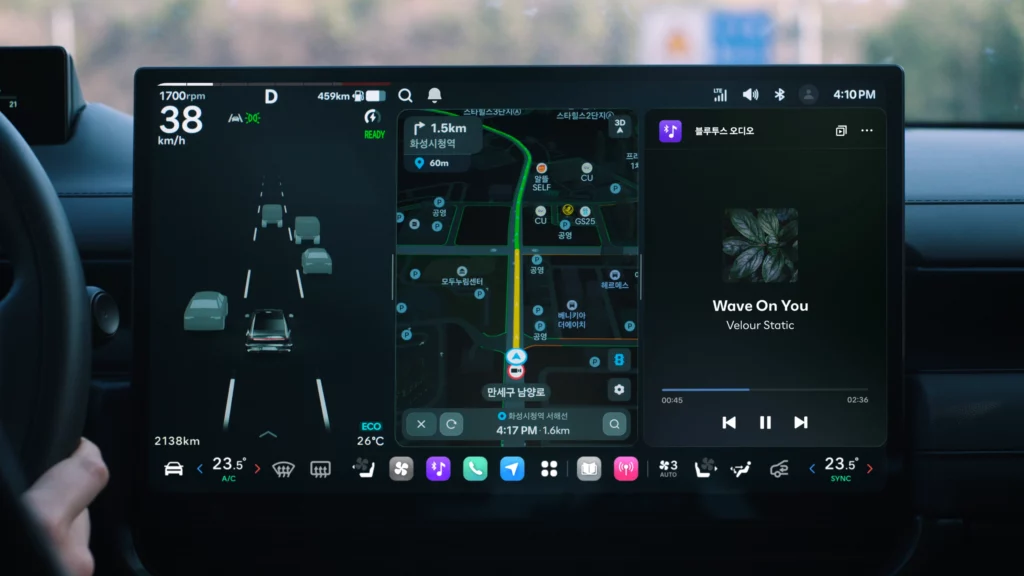
Hyundai embeds GenAI assistant Gleo AI into Pleos Connect, reshaping in-car control, navigation, and apps.
Hyundai Pleos Connect uses the GenAI Gleo AI, a large language model assistant, to unify in-car interactions. Traditional infotainment systems struggle with fragmented controls and high driver distraction. And so, GenAI addresses this by turning commands into natural conversation and reducing menu complexity. Legacy infotainment platforms also fail to personalize experiences across different drivers and journeys. Gleo AI learns preferences over time to deliver more relevant in-car assistance. And so, it positions vehicles as conversational digital spaces.
The system redesigns navigation using GenAI-driven context and real-time data processing. It simplifies information using adaptive layouts that prioritize frequent driver needs. This reduces cognitive load and improves safety during driving tasks. GenAI enables dynamic routing adjustments based on live traffic and user intent signals. It also reduces reliance on fixed menus that slow down driver interactions. Together these GenAI systems reduce driver distraction while improving decision speed in complex environments.
Gleo AI overcomes rigid voice systems by understanding intent in context-rich driving situations. It processes multi-command requests and adapts responses based on cabin zone detection. And thus, this enables natural control of navigation, climate, and infotainment functions. Safety improves as GenAI minimizes screen dependency through conversational control. Personalized responses help drivers access information faster without manual navigation. As a result, these improvements mark a shift from rule-based systems to adaptive GenAI-driven mobility interfaces.
An open App Market extends GenAI capabilities beyond driving into entertainment and services. Developers use APIs to integrate apps that interact with Gleo AI through voice. OTA updates continuously improve model behavior and system performance at scale. This creates a scalable ecosystem where in-car GenAI evolves like mobile apps. As a result, over time vehicles shift toward software-defined experiences powered by continuous model upgrades.
Why it matters
This case shows how GenAI reshapes vehicles into conversational computing platforms.
• It solves fragmented infotainment by unifying control through natural language interfaces
• It reduces driver distraction using context-aware voice interaction and adaptive UI systems
• It enables real-time personalization inside vehicles using continuous learning models
• It turns cars into software-defined ecosystems with upgradeable GenAI capabilities


