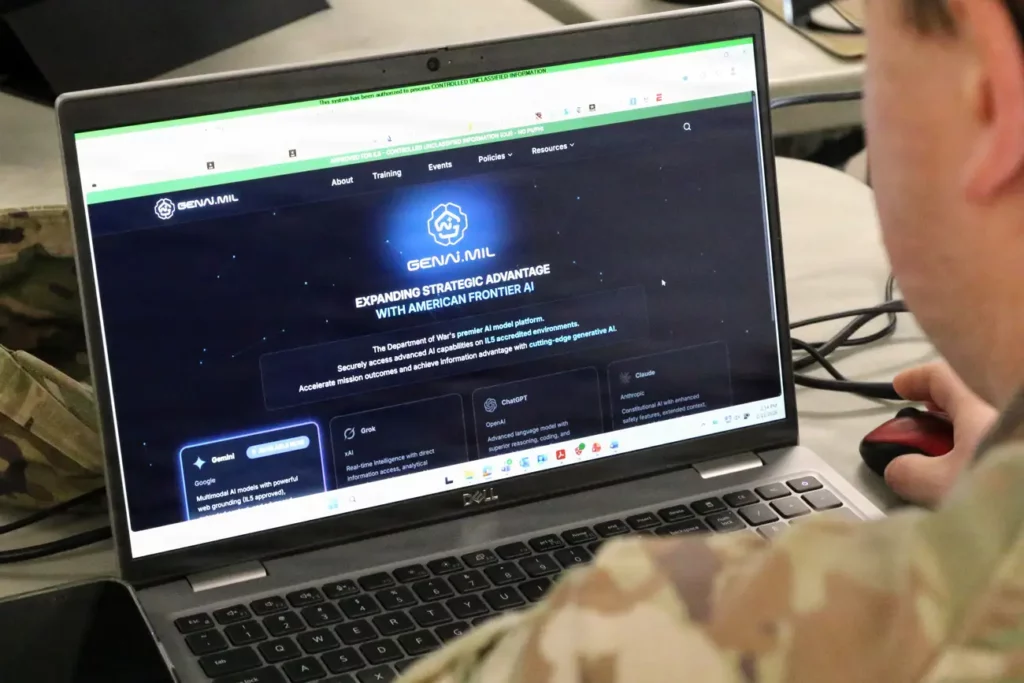
The U.S. Defense Department scales GenAI to 1.5 million daily users, cutting routine work and boosting workforce productivity.
The U.S. Department of Defense has rapidly expanded adoption of its GenAI platform, GenAI.mil, reaching 1.5 million daily users within six months. The platform helps employees automate repetitive administrative work, allowing staff to spend more time on higher-value responsibilities. Clear usage policies and easier access helped remove earlier barriers that slowed adoption.
The biggest challenge was not the technology itself. Many employees were unsure when and how they could use GenAI safely. The Pentagon addressed this by introducing clearer governance, integrating Google’s Gemini into unclassified networks, and sharing successful use cases across departments. This encouraged wider confidence while keeping humans responsible for final decisions.
Today, employees use GenAI for drafting reports, preparing job descriptions, summarizing large document collections, and producing congressional reports in hours instead of weeks. Rather than replacing workers, GenAI reduces manual effort and cognitive overload. This allows experienced personnel to focus on analysis, planning, and mission-critical work. The department is also exploring GenAI for faster data analysis in defense operations while maintaining strict human oversight.
The Pentagon’s experience shows that enterprise GenAI success depends as much on governance as technology. Organizations often struggle because employees lack clear policies, trusted platforms, and practical examples. This rollout demonstrates that enterprise adoption accelerates when GenAI is embedded into everyday workflows, supported by strong guardrails, and focused on solving real productivity problems instead of showcasing new technology.
Why it matters
Large organizations often struggle to scale GenAI beyond pilot projects.
• Clear governance removes uncertainty and encourages employee adoption.
• Embedding GenAI into daily workflows creates measurable productivity gains.
• Practical business use cases drive adoption faster than technology demonstrations.
• Human oversight remains essential for high-stakes decisions.


