Utopai PAI 2.0 tackles one of GenAI video’s biggest challenges: creating consistent long-form content without fragmented workflows.
Utopai Studios has launched PAI 2.0, the latest version of its GenAI video platform for creators, agencies, and enterprise content teams. Rather than focusing only on faster video generation, the platform addresses a larger production challenge. Long-form AI video often requires multiple disconnected tools, repeated editing, and constant prompt revisions. These fragmented workflows increase production time while making it difficult to maintain narrative consistency across scenes.
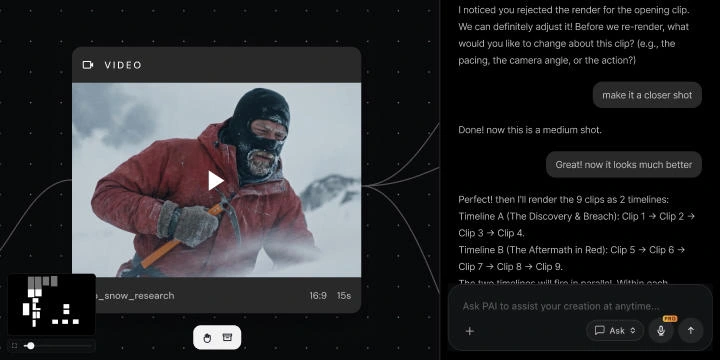
PAI 2.0 introduces a workflow that combines planning, storyboarding, editing, and video generation inside one platform. A new creative agent, voice input, rapid variant generation, and production-ready 4K rendering simplify the creative process. The platform also generates structured keyframes for each video segment, helping creators preserve story continuity. Instead of rebuilding scenes repeatedly, users can modify specific parts while maintaining the overall narrative and visual style.
Another major challenge in GenAI video production is balancing automation with creative control. Many video models generate isolated clips but struggle with extended storytelling. PAI 2.0 addresses this through Easy Mode for guided production and Pro Mode for detailed editing. The Canvas workspace enables creators to organize assets, refine scenes, and regenerate selected sequences without restarting entire projects. This reduces unnecessary model usage, shortens revision cycles, and improves production efficiency.
The broader significance reaches beyond media production. Many enterprises are adopting GenAI for marketing, training, product demonstrations, and customer communications. Their biggest obstacle is no longer video generation itself. It is managing complex production workflows while maintaining quality and consistency. PAI 2.0 demonstrates that the next stage of GenAI adoption will depend on orchestration, editing precision, and workflow integration rather than increasingly powerful models alone.
Why it matters
PAI 2.0 highlights how workflow orchestration is becoming the next competitive advantage in GenAI content production.
• It solves fragmented AI video production across multiple creative tools.
• It reduces costly revisions through structured planning and selective editing.
• It improves narrative consistency across long-form GenAI video projects.
• It combines automation with granular creative control for enterprise users.
• It represents a broader enterprise need for integrated GenAI production workflows.
• It shows that workflow design increasingly determines GenAI productivity and scalability.