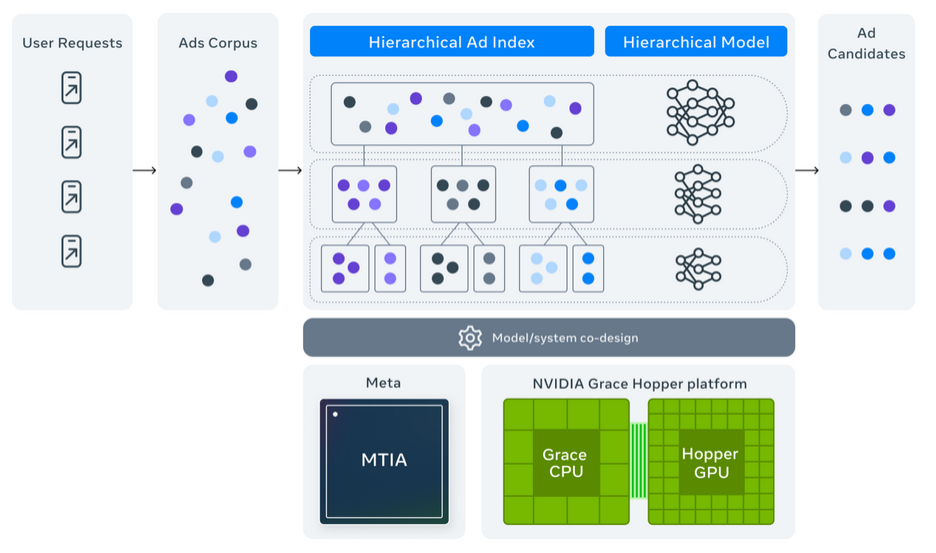
Meta Andromeda and GEM rebuilt its ad platform around GenAI, shifting control from manual targeting to machine-driven creative intelligence.
The advertising platform has undergone a structural transformation driven by GenAI. Meta Andromeda and GEM rebuilt its ad platform around GenAI, shifting control from manual targeting to machine-driven creative intelligence. Signal loss from privacy changes broke audience-first targeting. Manual optimization became unreliable at scale. Meta responded by rebuilding ad delivery around two GenAI systems: Andromeda and GEM. Together, they automate ad selection, ranking, and sequencing across Meta’s ecosystem.
Andromeda is a generative retrieval engine that decides which ads are eligible for each user. It no longer starts with advertiser-defined audiences. Instead, it evaluates creatives, formats, copy, and historical engagement signals. This reverses traditional logic and makes creative quality the dominant optimization input. Broad targeting outperforms segmentation because GenAI requires large opportunity pools.
GEM acts as Meta’s generative intelligence layer. It analyzes user behavior, ad sequences, formats, and outcomes across time. GEM predicts what should be shown next, not just what qualifies. These predictions feed back into Andromeda, creating a continuous learning loop. Meta reports GEM delivers four times greater performance efficiency than previous ranking models.
Why it matters
• Enterprise advertising now depends on GenAI learning systems, not manual controls
• Creative strategy replaces targeting as the primary performance lever
• This model mirrors broader enterprise shifts toward AI-managed decision systems
This case extends beyond Meta. It represents a common enterprise problem: optimizing outcomes under uncertainty with degraded signals. GenAI solves this by learning patterns across large, noisy datasets. Advertisers must adapt by supplying diverse, high-quality creative inputs and stable learning conditions. Control shifts from execution to strategy.