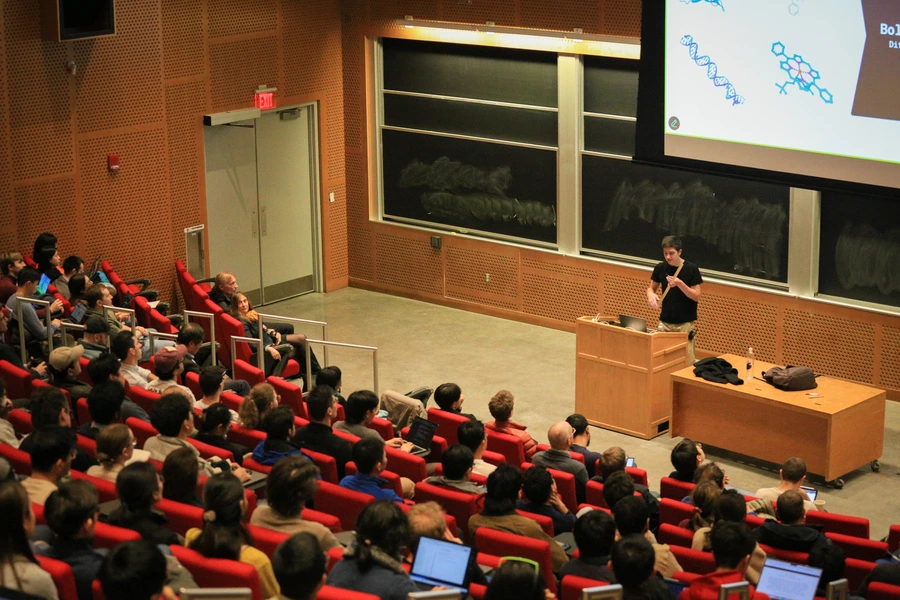
MIT researchers debuts BoltzGen, a GenAI model that generates drug-ready protein binders for hard disease targets.
MIT researchers have introduced BoltzGen, a GenAI model designed to create protein binders for disease targets that are difficult to treat with current methods. Traditional computational tools can either predict molecular structure or design proteins, but they struggle on “undruggable” targets. As a result fail when training data diverges from real-world biology. BoltzGen addresses this limitation by unifying structure prediction. As well as binder generation within a single multimodal model that learns generalizable physical patterns rather than memorizing familiar cases.
BoltzGen builds upon earlier Boltz models but advances beyond prediction into end-to-end molecular creation. It incorporates constraints from wetlab teams. Wherein this prevents the model from producing proteins that violate chemical or physical rules. This ensures generated binders are viable candidates for therapeutic pipelines. The model also introduces an evaluation protocol that tests performance on targets far outside the training distribution, which exposes failure points that past systems rarely reveal. By doing so, it closes a major gap in AI-driven drug design, where many models appear strong on paper but falter against novel biology.
In validation studies across eight wetlabs, BoltzGen generated binders for 26 diverse targets, including several that lacked previous binder structures. The model sustained high performance even when confronted with targets chosen for their dissimilarity to its training data. Industry collaborators, such as Parabilis Medicines, reported that BoltzGen could accelerate peptide design workflows and shorten cycles in early discovery. These results show that GenAI can push drug design from passive prediction to active engineering, enabling rapid exploration of molecular space with greater reliability.
BoltzGen’s open-source release signals a strategic shift in biotech, where advanced molecular design capabilities are becoming accessible to researchers worldwide. This creates competitive pressure for proprietary “binder-as-a-service” companies and accelerates community-wide innovation. MIT researchers see this democratization as essential to tackling unsolved therapeutic problems. By blending physics-aware modelling with generative design, BoltzGen marks a step toward AI systems that can engineer biology directly and expand the frontier of drug discovery.


