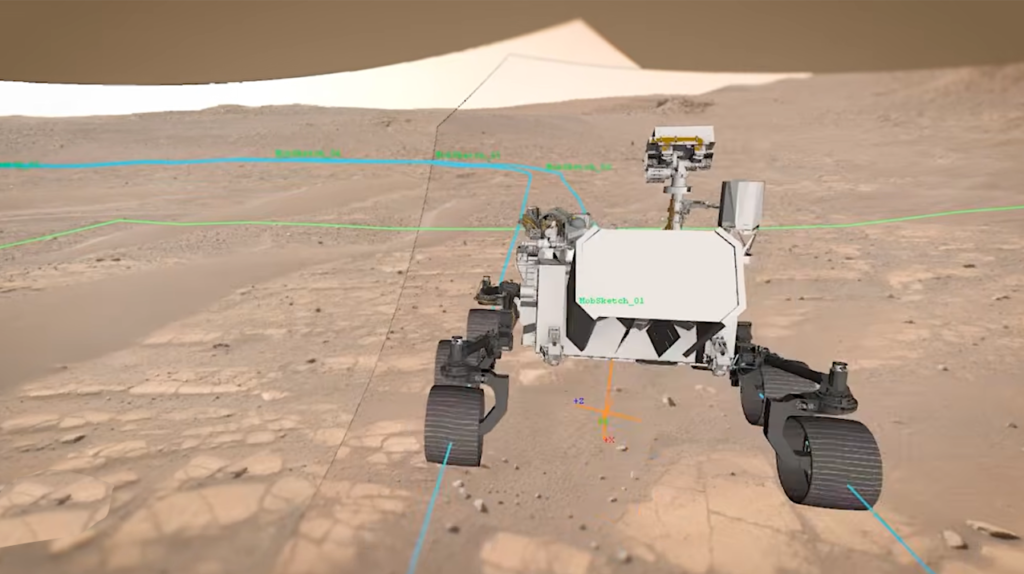
NASA equips Perseverance with GenAI to localize itself on Mars without human guidance as there is no GPS infrastructure.
NASA has equipped the Perseverance rover with GenAI to increase planetary autonomy. On Mars, there is no GPS infrastructure. Previously, rover operators on Earth manually corrected location drift after long drives. Visual odometry accumulated small errors that grew over distance. Now, Mars Global Localization uses AI-driven algorithms to match rover panoramas with orbital terrain maps onboard. The system determines position within 25 centimeters in about two minutes.
This breakthrough overcomes a fundamental robotics challenge: cumulative localization error in GPS-denied environments. Generative AI assists route planning by selecting waypoints, reducing reliance on human operators. The rover no longer waits a full day for Earth-based corrections. Instead, it self-validates its position and continues its preplanned drive. This dramatically expands daily travel distance while minimizing mission latency.
The solution runs on a commercial-grade processor originally deployed for the Ingenuity helicopter. Engineers implemented redundancy checks to ensure reliability in a radiation-heavy environment. During validation, the system accurately pinpointed all 264 historical rover stops. AI-enhanced localization and autonomous path planning now operate together, forming a closed-loop navigation intelligence stack.
Why it matters
Generative AI is moving from digital copilots to physical autonomy systems.
• AI enables precision navigation in GPS-denied, high-latency environments
• Autonomous localization reduces operational overhead and human intervention
• Intelligent waypoint selection accelerates exploration while preserving safety
This case represents a broader enterprise robotics challenge. Many industries operate in environments without reliable positioning systems. From mining to deep-sea exploration, machines must self-localize and adapt. NASA demonstrates how generative AI can embed decision intelligence directly into edge hardware. As AI-driven autonomy scales, organizations must design systems that combine localization, planning, and validation in real time. The shift signals the rise of AI-native autonomous infrastructure.