New Relic uses GenAI on AWS to turn fragmented enterprise knowledge into an intelligent productivity engine.
New Relic built a GenAI assistant called NOVA to solve a costly enterprise problem. Engineers were losing hours searching fragmented documentation across Confluence. As well as GitHub, Slack, and Salesforce. Some internal queries took more than a day to resolve. Hence, instead of adding more documentation layers, New Relic deployed GenAI on AWS to unify knowledge access and automate workflows. As such, NOVA now acts as a centralized intelligence layer across enterprise systems.
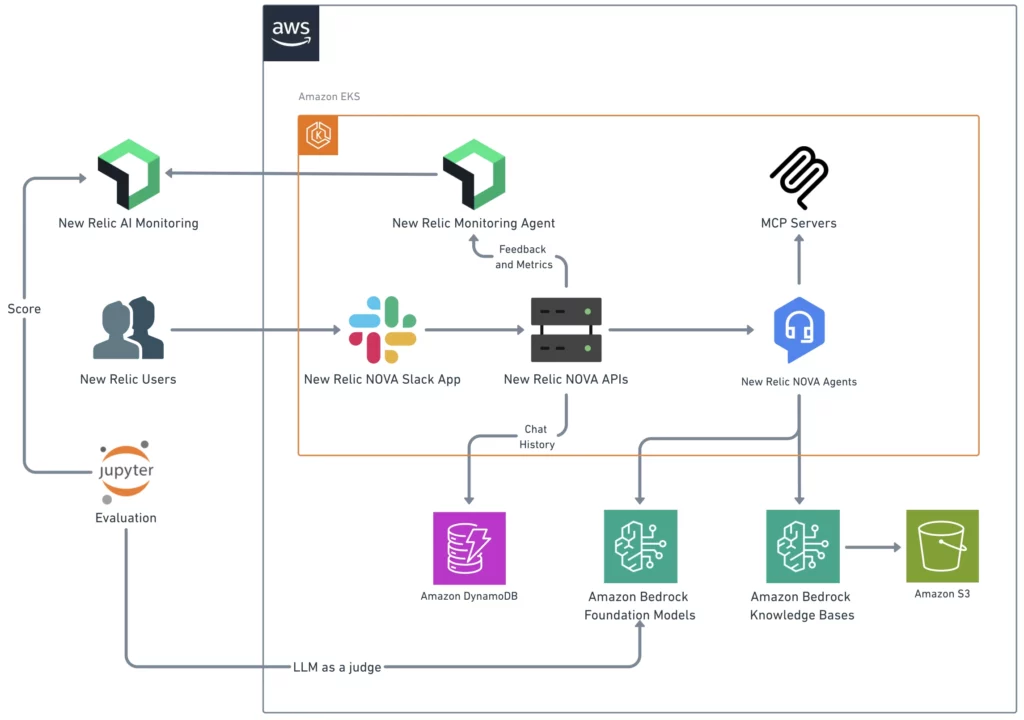
The architecture combines Amazon Bedrock, Amazon Kendra, and retrieval-augmented generation. NOVA ingests enriched documents, applies hierarchical chunking, and routes queries through specialized AI agents. Furthermore, this design overcomes a common GenAI challenge: maintaining accuracy across multiple data sources. The system preserves security with PII masking and evaluation frameworks. As a result, this delivers responses within 20 seconds while maintaining 80% accuracy across knowledge and transactional tasks.
Beyond document retrieval, NOVA executes operational workflows through agent orchestration. Moreover, it handles permission requests, rate limits, and system queries using structured AI agents. Model selection balances latency and cost by switching between Nova Lite and Nova Pro. This flexible architecture prevents overuse of large models. As a result, NOVA processes more than 1,000 daily queries while reducing search time by 95%.
Why it matters:
• New Relic demonstrates how GenAI can evolve from chatbot to enterprise operating layer.
• Enterprises must unify fragmented knowledge across SaaS systems
• RAG and agent orchestration enable GenAI to execute tasks, not just answer questions
• Model selection and observability frameworks are critical for scalable AI governance
This case reflects a broader enterprise challenge: converting institutional knowledge into actionable intelligence. Many organizations struggle with information silos and workflow bottlenecks. New Relic shows that GenAI, when architected with governance and retrieval discipline, becomes infrastructure. For this purpose, the lesson extends beyond observability platforms. Enterprises that integrate RAG, agent frameworks, and continuous evaluation will unlock durable productivity gains.