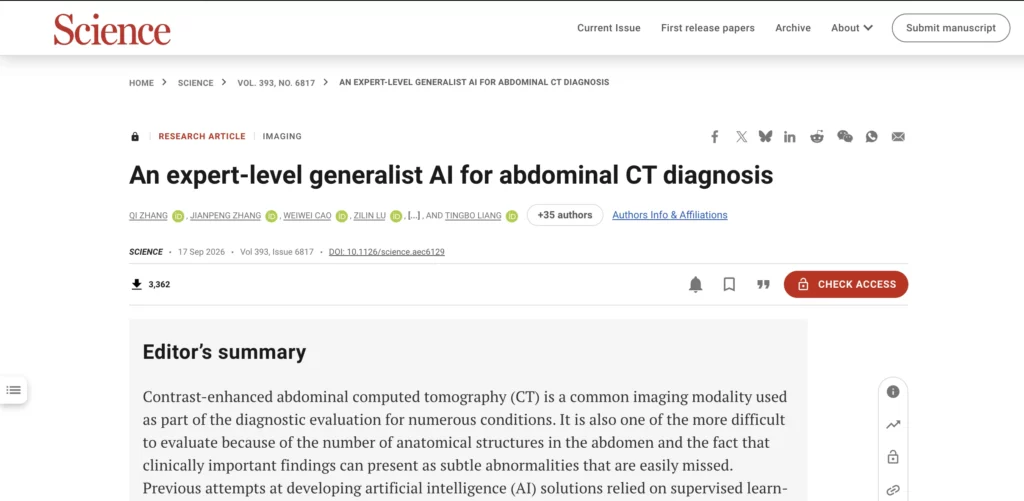
Alibaba’s DAMO Academy released a GenAI medical imaging model that screens 146 abdominal conditions and outperformed 23 of 26 radiologists.
Alibaba Publishes Its GenAI Medical Imaging Model in Science
Alibaba’s DAMO Academy research division published the model, called DAMO RADAR, in the journal Science on 17 September 2026 under the title An expert-level generalist AI for abdominal CT diagnosis. The system reads a single contrast-enhanced abdominal CT scan and reports findings across 18 organs. Its developers describe it as the world’s first expert-level generalist medical imaging model. In addition, Alibaba released the code openly on GitHub and Hugging Face under an Apache 2.0 licence, with model weights available for research use.
The Problem the GenAI Medical Imaging Model Addresses
A radiologist reading an abdominal CT is looking for many different things at once. Most clinical AI tools are narrow, because each one is trained to spot a single disease. As a result, a hospital that wants broad coverage has to run several separate systems. DAMO RADAR instead takes one pass at the whole scan.
To build it, the team trained on 420,000 contrast-enhanced abdominal CT examinations and generated 15 million anatomy-aware image-text pairs. Rather than matching a whole image to a whole report, the method breaks each scan down organ by organ, then links each organ to the matching sentences in the radiology report.
Results and Limits of the GenAI Medical Imaging Model
Across 146 clinical findings the model reached a mean AUC of 0.913. It was then validated at eight independent Chinese clinical centres on roughly 40,000 real-world examinations, where it outperformed 23 of 26 specialist radiologists in a head-to-head comparison. Meanwhile, when radiologists worked alongside the model instead of alone, disease-detection sensitivity rose by about 10 percentage points and reading time fell by more than 30%.
However, the limits are stated plainly. The model has no FDA clearance. It has been validated only on Chinese patient populations, and it covers contrast-enhanced abdominal CT alone. Prospective clinical trial results have not yet been reported. For comparison, other research groups have applied GenAI to narrower scientific problems, such as Lantern Pharma’s work on drug discovery.
Why It Matters
- An open licence moves the decision for a hospital away from picking a vendor and towards a harder question: does it have the data governance and validation capacity to run a clinical model itself?
- A generalist model competes with a portfolio of narrow tools. The signal that it is time to look is when a team is maintaining several single-disease systems side by side.
- Peer review plus external multi-centre validation is a reasonable bar to put to any supplier of clinical AI, and few clear it.
- Population and scan-type limits decide whether results transfer. Performance measured on one country’s patients does not carry over automatically.
Reported by South China Morning Post and Tech Times.