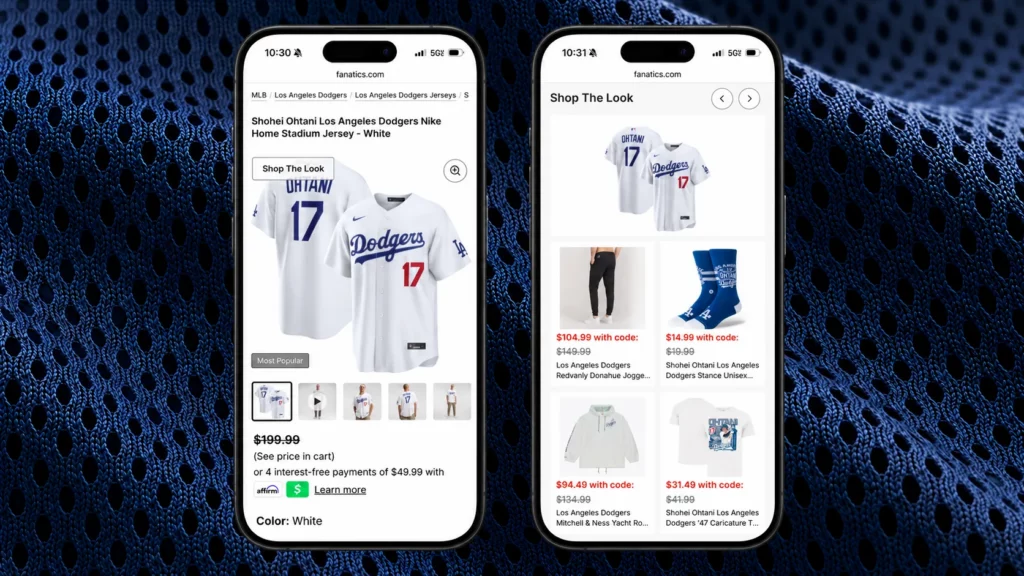
Fanatics rolled out GenAI outfit recommendations across its sports stores, lifting views of suggested items by 10% in testing.
Fanatics Brings GenAI Outfit Recommendations to Team Stores
Fanatics sells licensed sports merchandise. Its commerce arm produces more than 45 million items a year and sells in over 180 countries. At any one time its catalogue holds more than 1.5 million unique SKUs across hundreds of sites, and it adds upwards of 1,000 new products every week.
The company has now rebuilt its “Shop the Look” feature using models from OpenAI. These GenAI outfit recommendations are live on Fanatics.com and on the official NFL, NBA, MLB and NHL online stores.
Why Discovery Needed GenAI Outfit Recommendations
Shopping sessions on Fanatics sites averaged more than 30 minutes, and the company said discovery had become the bottleneck. Meanwhile the catalogue keeps turning over, with new products arriving every week.
Now, when a fan opens a team jersey page, the site suggests a complete outfit built only from items it can ship. OpenAI models draw on enriched product, team and inventory data. Fanatics applies its own merchandising rules on top, so the picks stay on the right team. Justin Tsai, chief product officer for Fanatics Commerce, told CNBC that team fit is essential, because a Dodgers fan does not want a Giants item appearing in their suggestions. The looks refresh daily as the catalogue changes.
Fanatics engineers built the tooling themselves using Codex, OpenAI’s coding assistant. They generated and tested the first 50 looks in under a day. As a result, the company approved a minimum viable product the same week, then scaled the approach to thousands of products.
What the Results Show
The two companies tested the GenAI outfit recommendations across roughly 30,000 MLB products. Views of recommended items rose 10% against the previous version of the feature. However, neither company published a baseline or a measurement window, so the figure reads as an early signal rather than a settled result. Tsai said the suggestions give shoppers “more conviction” in larger purchases such as an authentic jersey.
Team merchandise is Fanatics’ largest revenue source. Chief executive Michael Rubin said commerce will exceed $7 billion in revenue this year, against roughly $5.5 billion for collectibles. Other retailers are moving the same way: eBay has built its own AI-powered fashion finder for a similarly large and fast-moving catalogue.
Why It Matters
- Catalogue velocity, not catalogue size, is the signal to watch. When a retailer adds products faster than merchandising can photograph and pair them, hand-curated discovery stops scaling.
- The hard part is the business logic, not the model. What keeps a wrong-team item out of a recommendation is written-down merchandising rules. Retailers without those rules documented will struggle to copy this.
- A recommendation prototype that cannot be judged within a week usually points at the data layer rather than the model. Product, team and inventory data has to be in usable shape before anything can be tested at all.
- Treat an engagement lift as a reason to instrument, not a result to bank. Without conversion or basket data, a 10% rise in views does not yet prove revenue impact.


