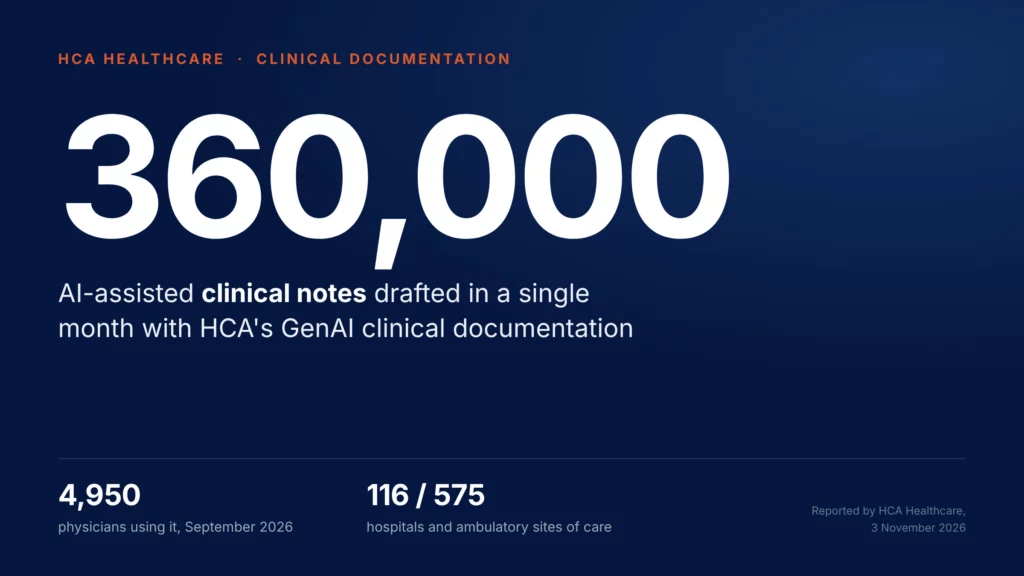
HCA Healthcare’s GenAI clinical documentation produced more than 360,000 draft notes in a single month.
Where HCA Runs Its GenAI Clinical Documentation
HCA Healthcare, a hospital operator with roughly 189 hospitals, has moved ambient note drafting into everyday clinical use. In September 2026, 4,950 physicians used the tool across 116 hospitals and 575 ambulatory sites of care. Together they generated more than 360,000 AI-assisted clinical notes that month. The company expects about 10,000 physicians to be using it by the end of 2026.
What GenAI Clinical Documentation Actually Does
A clinical note is the written record of a patient visit. A physician has to produce one for every encounter, and writing it takes time. HCA’s system listens to the conversation in the room instead. GenAI then prepares a draft note from what it heard. The physician reviews and approves that draft before it enters the record, so nothing is filed without a human signature.
Mangesh Patil, HCA’s chief AI officer, has said the company does not roll out every tool it tries. “In healthcare, ‘not yet’ can be an important decision,” he told Becker’s Hospital Review. Higher-risk tools therefore receive extra review and monitoring before they reach patients.
The Time Physicians Got Back
HCA measures GenAI clinical documentation in clinician time. A 2025 case study in its North Texas division found providers gained one to two hours per shift. They also spent five fewer minutes per patient on history and physical notes. In addition, outpatient clinics have seen higher throughput, after some physicians added patients to their schedules. These figures are HCA’s own measurements rather than an independent assessment.
Other healthcare organisations report comparable gains in service work rather than clinical work. AOK PLUS, a German public health insurer, unified its member service on GenAI.
Why It Matters
- In ambient documentation the user and the beneficiary are the same person. That is why uptake spreads without a mandate.
- A human approval step is what keeps a clinical rollout defensible. The design choice is worth copying in any regulated workflow.
- The signal to watch is not test accuracy. It is whether clinicians still use the tool once the novelty wears off.
- Going from one division to more than a hundred hospitals is a training and change problem. It is rarely a model problem.


