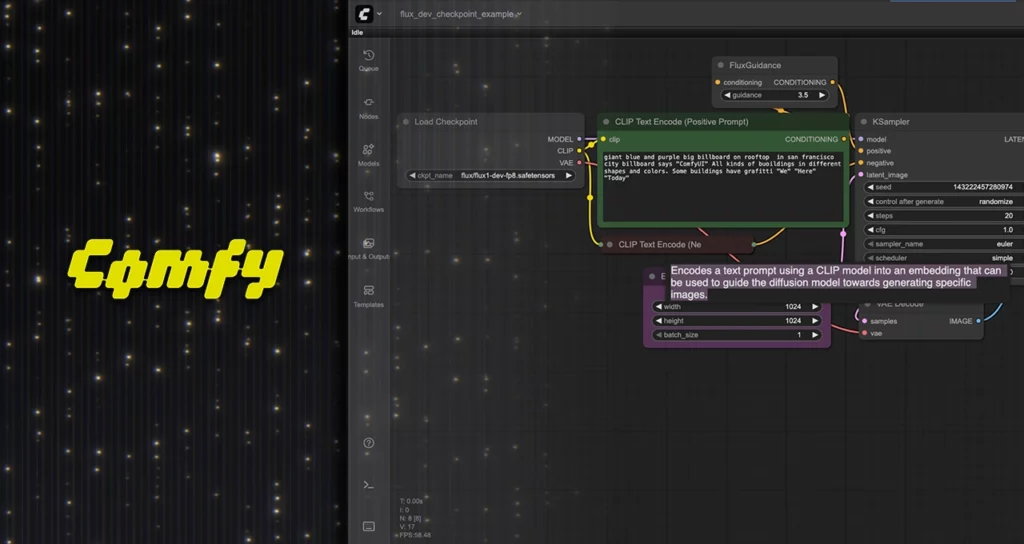
ComfyUI and NVIDIA RTX deliver faster GenAI workflows, cutting creation time and boosting efficiency for artists and developers.
ComfyUI, the open-source node-based interface for GenAI workflows, has released major updates that reshape creative content production. With NVIDIA RTX AI PCs, the platform now runs up to 40% faster and supports leading-edge models like Wan 2.2, Qwen-Image, FLUX.1 Krea [dev], and Hunyuan3D 2.1.
The upgrades solve a core challenge: creative models often demand heavy compute power and large memory, slowing workflows. By partnering with NVIDIA, ComfyUI leverages TensorRT-optimized models, including Stable Diffusion 3.5 and FLUX.1 Kontext, cutting VRAM usage by 50% and tripling speed. These optimizations let creators run advanced models locally without cloud latency, making high-quality generative design more accessible.
For artists, the benefits are clear. Wan 2.2 enables smooth video transitions from simple prompts, while Qwen-Image excels at text rendering and precise edits. FLUX.1 Krea generates more realistic imagery with diverse styles, and Hunyuan3D 2.1 converts text or images into high-fidelity 3D assets. All of these models run significantly faster on RTX GPUs than on competing platforms, unlocking professional-grade content creation in real time.
To ease adoption, ComfyUI includes preconfigured templates for common GenAI tasks like upscaling, inpainting, or character consistency. Plug-ins for Photoshop, Blender, Nuke, and Unreal Engine let users integrate workflows directly into existing pipelines. This allows both solo creators and enterprises to streamline processes, reduce costs, and speed project delivery. With RTX acceleration and quantized models delivered via NVIDIA NIM microservices, ComfyUI ensures efficiency at scale while preserving creative quality.


