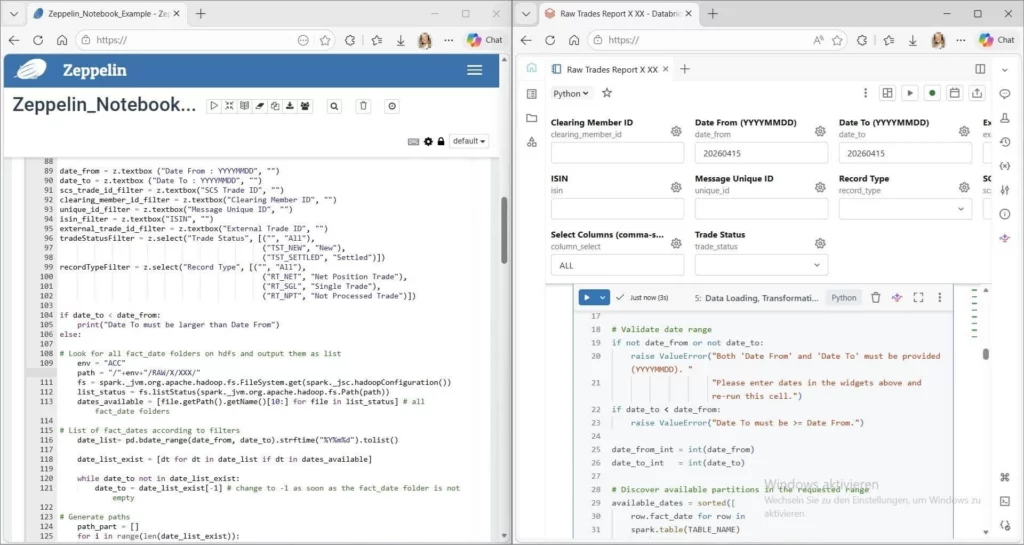
Deutsche Börse used GenAI to cut manual Zeppelin notebook migration work from hours to just under 20 minutes.
Deutsche Börse faced a major migration problem across its analytics infrastructure. More than 2,000 users relied on Zeppelin notebooks before Cloudera’s 2027 decommission deadline. Manual migration to Databricks would have required years of redevelopment work. The notebooks contained deeply customized SQL, Python logic, widgets, scheduling systems, and business workflows. Traditional rule-based automation failed because notebook structures varied too widely across teams and use cases.
The StatistiX team solved this using a hybrid GenAI migration strategy built on Databricks Apps. Instead of rewriting notebook logic automatically, the system separates deterministic tasks from contextual reasoning. Structural conversion became fully automated through GenAI-assisted processing. Zeppelin paragraphs converted into Databricks notebook cells while preserving original metadata and code structure. Context-aware prompts then guided Genie to rebuild notebook logic using Databricks-native workflows.
The biggest challenge involved preserving institutional knowledge without introducing migration errors. Fully automated rewriting risked breaking business-critical workflows and reducing user trust. Deutsche Börse intentionally left logic interpretation, Oracle references, and custom code reconstruction to GenAI conversations. Genie handled variability through contextual reasoning and clarifying questions instead of rigid automation rules. This approach reduced notebook redevelopment from several hours to roughly 15 to 20 minutes per notebook.
The broader enterprise significance extends far beyond notebook migration. Many enterprises struggle with large-scale modernization projects involving fragmented legacy systems and undocumented workflows. Deutsche Börse demonstrates how GenAI can accelerate migration without replacing human oversight. The case also highlights an important enterprise pattern: GenAI performs best when combined with structured automation and domain-specific context. Instead of replacing expertise, GenAI amplified user productivity and reduced technical migration barriers.
Why it matters
This case shows how GenAI can modernize legacy enterprise systems at scale.
• It solves large-scale migration bottlenecks without relying on brittle automation rules
• It combines deterministic automation with contextual GenAI reasoning
• It preserves business-critical logic while reducing redevelopment effort dramatically
• It lowers technical barriers for non-engineering users during platform migrations
• It represents a repeatable enterprise model for cloud and analytics modernization