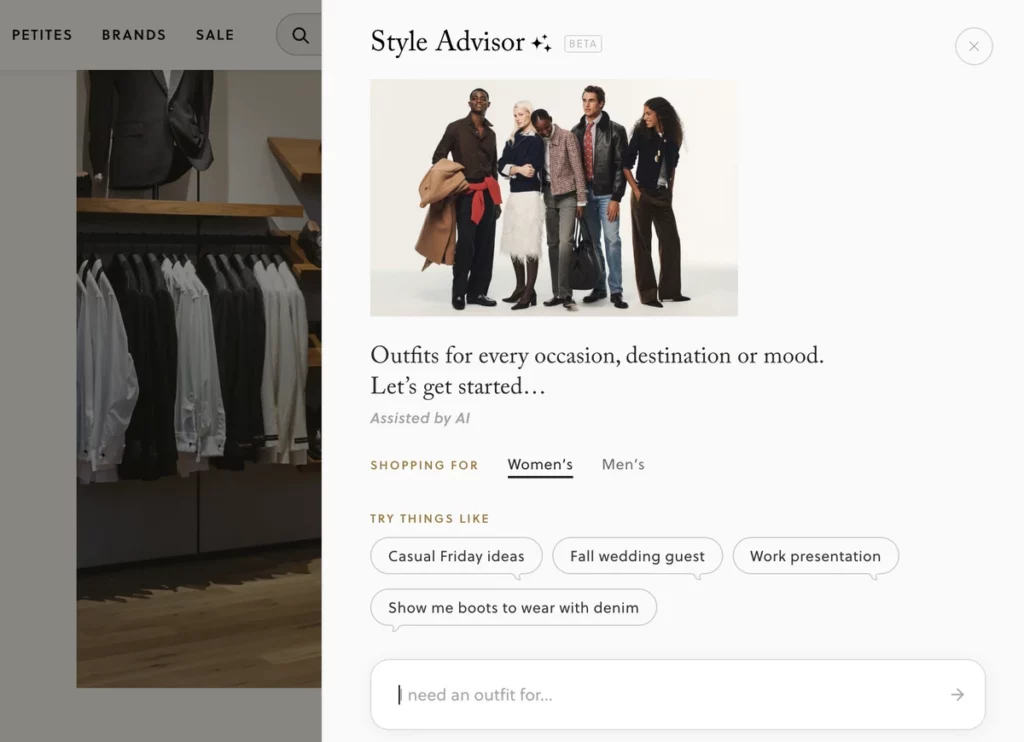
J.Crew has launched a GenAI style advisor that builds whole outfits from a shopper’s description of the occasion.
J.Crew Puts a Stylist on Its Website
J.Crew sells women’s and men’s clothing. Digital Commerce 360 ranks it No. 80 in its Top 1000 database of online retailers. The company has now launched Style Advisor. It is a conversational tool built on Anthropic’s Claude models. The tool runs on the desktop site in the United States, for both women’s and men’s styles. In addition, J.Crew plans a mobile app version later.
Why J.Crew Built a GenAI Style Advisor
J.Crew frames the problem around individual product searches. A customer who knows the occasion but not the garment must assemble the look alone. Danielle Schmelkin is J.Crew’s chief information officer. She put it this way: “It’s not just about the piece that you’re looking for, but how to style it.”
The GenAI style advisor works the other way around. A shopper describes an event, such as a beach wedding or a first job interview. The tool then returns complete looks. Those looks appear in photographs from J.Crew’s own catalog shoots. Afterwards, the shopper refines them in conversation. According to Fortune, the tool draws on thousands of outfit pairings from those shoots. It also applies the styling principles J.Crew’s stylists use in its stores.
The build followed an unusual route. A J.Crew digital product designer came up with the tool and made a working prototype. The idea did not start as a directive from the executive team. Engineers then took that prototype into production. Meanwhile, the company split the work across two tiers of model. J.Crew used one of Anthropic’s most capable models to design and prototype the experience. Afterwards, smaller and faster models handle each conversation. “They used a frontier model to build the experience and faster, more efficient models to run it,” said Paul Smith, Anthropic’s chief commercial officer. In addition, J.Crew built a back-end layer to monitor what the models cost to run.
What the GenAI Style Advisor Delivers So Far
At launch the tool is a working service rather than a measured result. J.Crew has published no usage, conversion or sales figures. Therefore the case currently rests on the shopping experience itself. However, the company says it plans to draw on each customer’s purchase history. It also wants to extend the GenAI style advisor to more markets and product lines.
“We see an opportunity to fundamentally rethink the shopping experience,” said Libby Wadle, chief executive officer of J.Crew Group.
Other retailers are moving the same way. Fanatics rebuilt its own GenAI outfit recommendations across its online sports stores last month. Meanwhile, retailer-built assistants still have ground to make up. Fortune cited McKinsey research on this point. It found that 56% of consumers use AI chat or search tools. However, only 27% turn to assistants built by retailers themselves.
Why It Matters
- A styled archive is the real prerequisite. J.Crew already had years of photographed outfit pairings. Therefore the model’s job was retrieval and judgment rather than invention. Retailers without that asset have to build it first.
- The build pattern is worth copying before the product is. An expensive model designs and prototypes the experience, then cheaper ones serve live traffic. As a result, a customer-facing assistant stays affordable once volume arrives.
- A launch without numbers is a prompt to ask what the team measures. Conversion, basket size and return rates will show whether outfit-led shopping pays.
- Starting from a designer’s prototype costs little. Therefore a company can test whether an assistant is worth productionizing before it commits.


